
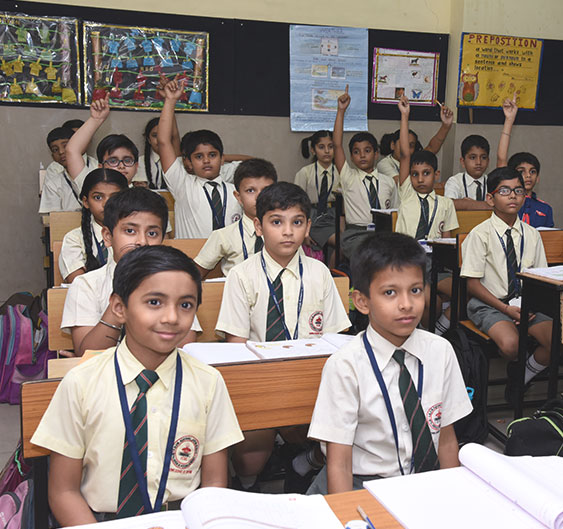
The Primary years are when children begin to move from learning through exploration to understanding ideas in greater depth. At S. J. Poddar Academy, we work towards building strong foundations in language, mathematics, science, social studies and other areas while ensuring that learning remains engaging, purposeful and connected to everyday life.
Our teachers make conscious efforts to move beyond the textbook. A lesson may begin with a question, a picture, a short film, an experiment, a story or a real-life situation. Children may then work in groups, discuss their ideas, create a model, conduct an activity or present what they have discovered.
This allows children to become active participants in the classroom rather than passive recipients of information.
Learning by Doing
Experiments, activities, projects and demonstrations help children understand concepts rather than simply remember them.
Learning through Questions
Children are encouraged to ask questions, investigate, make connections and arrive at their own conclusions.
Art-Integrated Learning
Art, music, drama, craft and creative expression are woven into academic learning to make concepts more meaningful and memorable.
Interdisciplinary Learning
Children begin to see connections between subjects. A topic such as water, for example, can lead to learning in Science, Geography, Mathematics, Language and Art.
Technology as a Learning Tool
Interactive panels, digital resources, educational applications and multimedia are used to enrich classroom experiences and provide children with different ways of understanding a concept.
Film Pedagogy
In collaboration with Purple People Labs, learning through film pedagogy has brought much needed change in critical thinking and problem solving skills among the students. Age-appropriate films and visual narratives are used to stimulate discussion, develop observation and encourage children to look at situations from different perspectives.
Collaborative Learning
Pair work, group activities, peer discussions and presentations help children learn to listen, share ideas and work with others.
We believe that education becomes richer when children are given opportunities to discover interests beyond their regular subjects. Our various clubs and enrichment activities provide children with spaces to explore their talents, develop new interests and learn from one another.
Through club activities, students get opportunities to engage in areas such as creative arts, literature, communication, science, technology and other interest-based activities. These experiences encourage curiosity and give children the confidence to try something new.
Financial Literacy is introduced at an age-appropriate level to help children understand the value of money, saving, spending wisely, needs and wants, and making responsible choices. The objective is to develop practical habits that children can carry into everyday life.
Value Education is an integral part of school life. Through stories, discussions, activities, classroom situations and everyday interactions, children learn about respect, empathy, honesty, kindness, responsibility, cooperation and caring for others. Values are not taught merely as lessons; they are encouraged through the way children interact and work together.
Growing up is as much about understanding oneself and others as it is about learning academic concepts. Our Social-Emotional Learning (SEL) initiatives help children recognise and express their emotions, develop empathy, manage challenges, build healthy relationships and make responsible choices.
Through conversations, stories, activities and classroom experiences, children are encouraged to understand that their feelings matter and that it is equally important to listen to and respect the feelings of others. These experiences help build self-awareness, confidence, resilience and positive relationships.
Physical development is an important part of a child's overall growth. Along with sports and physical education, Karate, Martial Arts, Skating, Football, Volleyball, Basket Ball, Cricket, Chess, Carrom, Yoga, and Lawn Tennis provides children with an opportunity to develop fitness, coordination, concentration, discipline and self-confidence.
The emphasis is not simply on learning techniques, but on developing qualities such as focus, perseverance, self-control and respect.
The Educational Studio provides an exciting space where learning can take a different form. It brings together technology, creativity, communication and experiential learning, allowing students to engage with ideas through a variety of media and activities.
The Studio also supports our growing use of film pedagogy and visual learning. Children can watch, observe, discuss, interpret and create, making learning more engaging while developing their ability to communicate and think critically.
Our Primary programme also provides opportunities for children to explore STEM activities, coding, robotics, environmental projects, public speaking, financial literacy, creative arts, sports and performing arts.
Assessment too is becoming more meaningful. Instead of looking only at how much a child can remember, we increasingly look at how well the child can understand, apply, explain, reason and communicate.
Our aim is to ensure that children leave the Primary section with strong academic foundations, but also with the confidence to explore, the ability to work with others and the willingness to take on new challenges.
We want our Primary classrooms to be places where children can learn, question, create, express themselves and enjoy the process of discovering something new.